
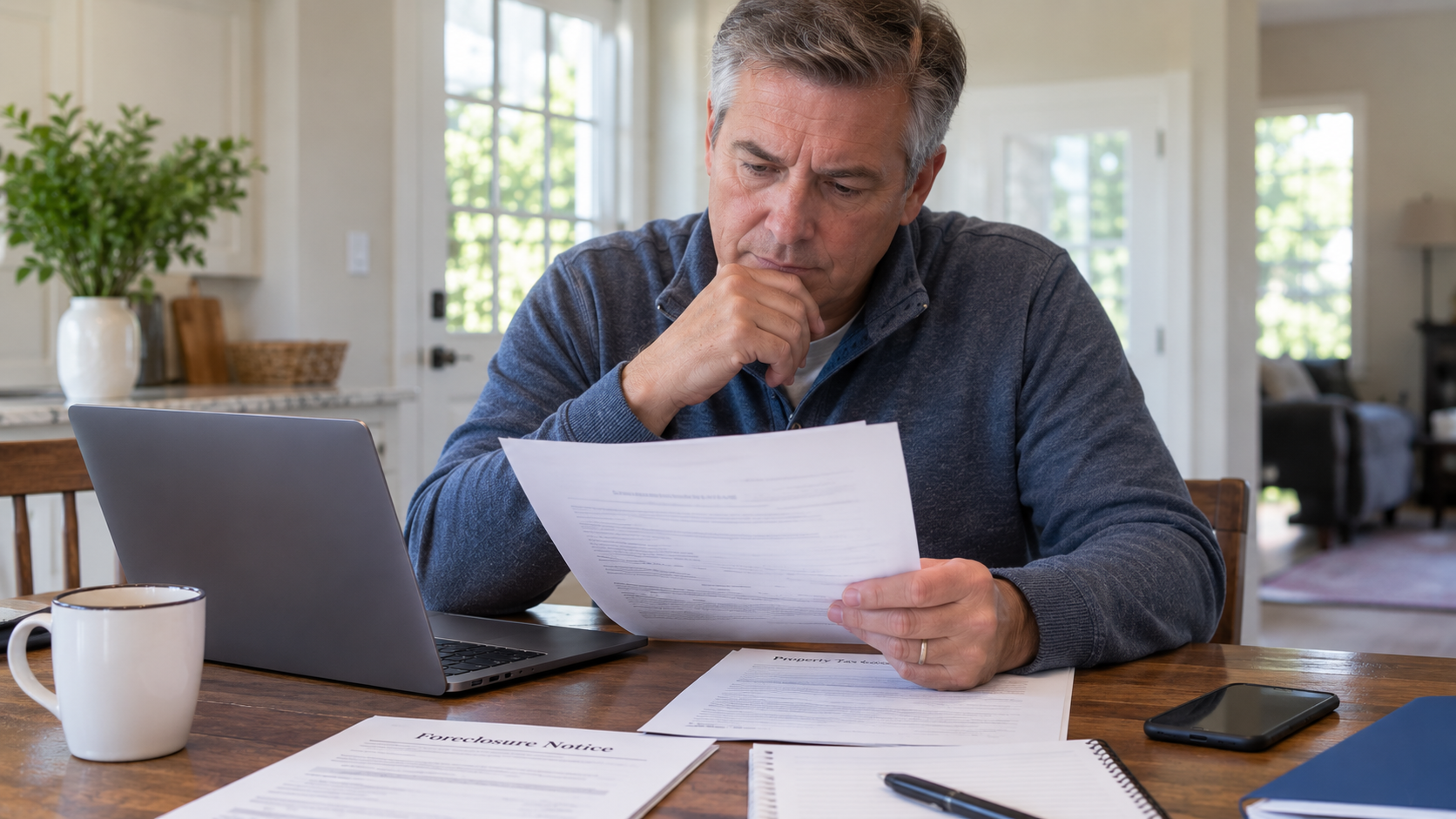
How do you claim surplus funds after a Johnston County foreclosure?
Surplus from a Johnston County foreclosure sale is paid to the person entitled to it where the trustee knows who that is, and otherwise to the Johnston County Clerk of Superior Court in Smithfield. Money held by the clerk is claimed by a special proceeding under N.C.G.S. 45-21.32, which any person claiming the money may start.
Johnston County recorded 344 foreclosure filings in 2025, which ranked eighth of North Carolina's 100 counties that year.
Johnston County includes Clayton, Smithfield, Selma, Benson and Four Oaks. Where a sale clears the costs of sale, the taxes, the assessments and the secured debt, what remains is not retained by the foreclosing lender. This page covers where that money goes in Johnston County, how you find out whether any exists in your case, and who is ahead of you in line if it does.
Already know a Johnston County property you owned was sold at foreclosure? You can skip the explanation and request a free claim review. We can check with the clerk in Smithfield on whether anything is being held on your file.
Does a Johnston County foreclosure leave surplus funds?
A surplus exists when the foreclosure sale brings more than the costs and expenses of the sale, the unpaid taxes, the unpaid special assessments, and the obligation secured by the deed of trust, in that statutory order. Whatever remains after those four is the surplus.
According to N.C.G.S. 45-21.31(a), North Carolina General Assembly, as of September 2026.
The statute pays unpaid taxes and special assessments from the proceeds unless the notice of sale said the property would be sold subject to them and it was sold that way, in which case they are not deducted.
Two features of a foreclosure sale bear on whether a surplus arises. Equity that built up over years of ownership does not disappear because payments stopped. And the sale price is not fixed on the day of the auction: once the report of sale is filed with the clerk, anyone may place an upset bid for ten days. An upset bid must top the last bid by at least 5 percent, with a minimum increase of $750, and needs a deposit, and each one opens another ten-day period. A property that opened near the payoff amount can finish above it.
According to N.C.G.S. 45-21.26(a) and 45-21.27(a), North Carolina General Assembly, as of September 2026.
EXCEPTION. A tax foreclosure is a different proceeding. Under N.C.G.S. 45-21.2, Article 2A of Chapter 45 does not apply to foreclosure by action in court, and tax foreclosures follow their own statutory procedures, so the handling of any excess proceeds depends on the type of proceeding and the sale documents. Our comparison of tax and mortgage foreclosure surplus covers the difference.
Where is Johnston County surplus money held?
Where the person who held the sale knows who is entitled to the surplus, the statute has it paid directly to the person or persons entitled. It goes to the Clerk of Superior Court of the county of sale where the mortgagee or trustee is in doubt about who is entitled, the entitled people cannot be located, adverse claims are asserted, or the owner has died with no qualified and acting personal representative. For a Johnston County sale, that is the clerk in Smithfield.
According to N.C.G.S. 45-21.31(b), North Carolina General Assembly, as of September 2026.
So there is no single answer to where the money is. It depends on whether the person who held the sale knew who was entitled to it. That matters practically, because a former owner who moved, whose name changed, or whose co-owner was hard to reach may be a person entitled to the surplus whom the person who held the sale could not locate, which is one of the situations that sends the money to the clerk.
Johnston County Clerk of Superior Court
| Courthouse | 207 E Johnston St, Smithfield, NC 27577 |
| Mailing address | Johnston County Courthouse, PO Box 297, Smithfield, NC 27577 |
| Telephone | (919) 209-5400 |
| Hours | Monday through Friday, 8:00 AM to 5:00 PM |
| Accessible entrance | Side entrance off Second Street, ramp mid-block |
According to the Johnston County Courthouse location page, North Carolina Judicial Branch, retrieved September 15, 2026.
EXCEPTION. Money that sits with the clerk unclaimed may not stay there. Property held by a court is generally presumed abandoned one year after it becomes distributable, after which it may be reported and delivered to the State Treasurer under the unclaimed property process. Once that happens the claim runs through the unclaimed property process instead of through the clerk. See our explanation of foreclosure surplus and the state unclaimed property list.
How do you find out whether your sale left a surplus?
By special proceeding before the Clerk of Superior Court in the county where the sale was held. A special proceeding to determine ownership of the surplus may be instituted by any person claiming the money or any part of it, and both those who have filed notice of a claim with the clerk and those the petitioner knows assert a claim are made defendants.
According to N.C.G.S. 45-21.32(a) and (b), North Carolina General Assembly, as of September 2026.
Worth reading that statute closely, because it does two things at once. It does not require anyone to hire a lawyer. And it puts the work of identifying the claimants who must be named as defendants on whoever files, which starts with the title record and the court file.
That second part is where much of the work sits. Second mortgages, docketed judgments, tax liens, association assessments, a co-owner who was never located, or an estate that was never opened can all change who gets paid and in what order, and priority turns on the title record, the foreclosure documents and the applicable law. Our overview of how to claim surplus funds in North Carolina sets out the steps.
EXCEPTION. If an answer raises a factual dispute over who owns the surplus, the matter does not stay with the clerk. It is transferred to the civil issue docket of the superior court for trial. When a proceeding is transferred, the clerk may require any party who asserts a claim to the money by petition or answer to post a $200 bond for costs. The court may, in its discretion, allow a reasonable attorney's fee for the attorney appearing for the party who prevails, paid out of the money in dispute, and taxes all costs against the losing parties who asserted a claim by petition or answer.
According to N.C.G.S. 45-21.32(c) and (d), North Carolina General Assembly, as of September 2026.
How is a claim filed in Johnston County?
By special proceeding before the Clerk of Superior Court in the county where the sale was held. A special proceeding to determine ownership of the surplus may be instituted by any person claiming the money or any part of it, and both those who have filed notice of a claim with the clerk and those the petitioner knows assert a claim are made defendants.
According to N.C.G.S. 45-21.32(a) and (b), North Carolina General Assembly, as of September 2026.
Worth reading that statute closely, because it does two things at once. It does not require anyone to hire a lawyer. And it puts the work of identifying the claimants who must be named as defendants on whoever files, which starts with the title record and the court file.
That second part is where much of the work sits. Second mortgages, docketed judgments, tax liens, association assessments, a co-owner who was never located, or an estate that was never opened can all change who gets paid and in what order, and priority turns on the title record, the foreclosure documents and the applicable law. Our overview of how to claim surplus funds in North Carolina sets out the steps.
EXCEPTION. If an answer raises a factual dispute over who owns the surplus, the matter does not stay with the clerk. It is transferred to the civil issue docket of the superior court for trial. When a proceeding is transferred, the clerk may require any party who asserts a claim to the money by petition or answer to post a $200 bond for costs. The court may, in its discretion, allow a reasonable attorney's fee for the attorney appearing for the party who prevails, paid out of the money in dispute, and taxes all costs against the losing parties who asserted a claim by petition or answer.
According to N.C.G.S. 45-21.32(c) and (d), North Carolina General Assembly, as of September 2026.
What does it cost to claim surplus funds in Johnston County?
Our fee for a surplus funds claim is contingent: it comes out of the money recovered rather than being paid upfront. A special proceeding can also carry court costs, and the written fee agreement sets out how those are handled on a particular file.
A contingent fee lets a client pursue a claim on money that may or may not be there without paying an attorney fee upfront, and the written agreement says which costs the client could still owe.
Four common costs in a surplus claim:
The court cost for filing the special proceeding with the clerk, set by statute and paid to the court rather than to us.
A title search, to identify which liens, judgments and other interests may sit ahead of the claim.
Service of process on the other parties who must be named in the proceeding.
The attorney fee, which is contingent and taken from what is recovered.
Ask any firm for those figures in writing before signing anything. Under Rule 1.5(c) of the North Carolina Rules of Professional Conduct, a contingent fee agreement must be in a writing signed by the client that states how the fee is calculated, which expenses come out of the recovery and whether before or after the fee is calculated, and any expenses the client will owe whether or not the client prevails. That agreement is where the costs question gets answered for your specific file rather than in general terms on a web page.
HOW WE HANDLE A JOHNSTON COUNTY CLAIM
We start with the file, not with a pitch. That means reading the final report and account from the sale, reviewing the court file to see whether the clerk is holding a surplus, and running the title work to find out who else has a claim before anything gets filed. If the record shows there is nothing to claim, we tell you that, and there is no charge for that initial review.
We handle claims for former owners who have moved out of Johnston County or out of North Carolina entirely.
To talk through your Johnston County file, call us at 919-647-9599.
Who else can claim the same money?
Which claims share in a surplus, and in what order, depends on the recorded interests, the foreclosure record, the applicable statutes and the facts of the particular case. The former owner is not automatically paid first where other recorded interests sit ahead.
Whether any of the following shares in a surplus, and in what order, turns on lien priority, notice and the foreclosure record. Potential claimants on a Johnston County surplus include:
The former owner or owners who lost the property at the sale.
Heirs or the estate of an owner who has died.
Holders of second mortgages and other junior deeds of trust.
Judgment creditors with judgments docketed in Johnston County.
Federal, state and local tax liens, whose treatment depends on statutory notice, priority and the facts of the sale.
A homeowners association with recorded assessment liens.
Our overview of who can claim surplus funds in North Carolina covers the priority order in detail.
What if the former owner has died?
The estate's personal representative acts for the estate. N.C.G.S. 45-21.31(b) sends the surplus to the clerk where an owner has died and no personal representative has qualified, so estate administration or the appointment of a personal representative may be needed before entitlement can be resolved.
According to N.C.G.S. 45-21.31(b), North Carolina General Assembly, as of September 2026.
A family member is not automatically entitled to collect on the strength of the relationship alone. If an estate needs to be opened, it is opened in the North Carolina county where the owner was domiciled at death or, if the owner was not domiciled in North Carolina, in a county where the owner left property or into which estate property has come, which may not be Johnston. Our guides to opening an estate to claim surplus funds and claiming a deceased parent's surplus funds cover what is involved.
How many foreclosures are filed in Johnston County?
Johnston County courts recorded 344 civil cases with a home or business foreclosure filing in 2025, compared with 296 in 2024, an increase of 16.2 percent. That ranked eighth among North Carolina's 100 counties.
According to the Foreclosure Filings report, North Carolina Administrative Office of the Courts, data through December 31, 2025, compiled January 7, 2026.
Johnston County foreclosure filings by calendar year
| Year | Filings |
|---|---|
| 2019 | 417 |
| 2020 | 168 |
| 2021 | 83 |
| 2022 | 214 |
| 2023 | 299 |
| 2024 | 296 |
| 2025 | 344 |
A filing is not a completed sale, and the report says so: it counts cases filed, not foreclosures granted. A case counted here may have ended in a reinstatement, a modification, a dismissal, or a bankruptcy rather than a sale. Our breakdown of the 2025 statewide filing numbers explains what the data can and cannot show.
EXCEPTION. This report carries no dollar figures at all. A rising filing count in Johnston County does not establish that more surplus money is being held, and the report counts cases filed rather than publishing county-level surplus balances. Whether a surplus exists is a question about one sale, answered by that sale's file.
Frequently Asked Questions
-
With the Clerk of Superior Court at the Johnston County Courthouse, 207 E Johnston St, Smithfield, NC 27577. The courthouse is open Monday through Friday, 8:00 AM to 5:00 PM, and the main number is (919) 209-5400.
-
No. N.C.G.S. 45-21.32(a) provides that a special proceeding may be instituted by any person claiming the money or any part of it. What subsection (b) requires is that both those who have filed notice of a claim with the clerk and those the petitioner knows assert a claim be made defendants, which means identifying and serving them.
-
Foreclosure surplus held by the clerk is tied to a specific case file and confirmed through the clerk's record. Money already delivered to the State Treasurer is searchable separately through the state unclaimed property system.
-
N.C.G.S. 45-21.32 sets no fixed deadline for the special proceeding. Waiting still carries cost. Money left with the clerk is generally presumed abandoned one year after it becomes distributable, after which the claim may run through the State Treasurer rather than the clerk. A presumption of abandonment is not the same as losing the right to the money.
-
Start with the final report and account the trustee filed with the clerk after the sale. Under N.C.G.S. 45-21.33 it must be filed within 30 days of the trustee receiving the proceeds, and it shows what came in and what was paid out.
-
Our fee is contingent: it comes out of the money recovered rather than being paid upfront. Separate from the fee, a claim can carry court costs, a title search and service of process on the other parties. The written fee agreement sets out how those are handled on a particular file.
-
The special proceeding is meant to bring the claims together, because those who filed notice of a claim and those the petitioner knows assert one are made parties, and a factual dispute over ownership moves to superior court. If an answer raises a factual dispute over ownership, the matter transfers to the civil issue docket of the superior court for trial.

Did you lose a Johnston County property at a foreclosure sale?
We can check whether the clerk in Smithfield is holding anything on your file, read the final report and account from the sale, and tell you what the record shows before you sign anything with anyone. If we can be of assistance to you, please reach out to us at 919-647-9599 or through our contact page.
If someone has already contacted you offering to find or collect the money for a percentage, read how surplus funds finders operate before you sign. Consider having a North Carolina attorney review the fee and the assignment language first.
ABOUT THE FIRM
Surplus Funds Attorney is the foreclosure surplus funds practice of The Walls Law Group, founded and led by Jason Walls, J.D. (Campbell University School of Law, undergraduate at North Carolina State University), North Carolina State Bar No. 34274, and a member of WealthCounsel. We handle surplus funds petitions before clerks of superior court across North Carolina, including for former owners who have moved out of state. Our office is at 5511 Capital Center Drive, Suite 180, Raleigh, NC 27606.
SOURCES
N.C.G.S. 45-21.2, Article not applicable to foreclosure by action in court.
N.C.G.S. 45-21.26 and 45-21.27, Report of sale and upset bids.
N.C.G.S. 45-21.31, Disposition of proceeds of sale; payment of surplus to clerk.
N.C.G.S. 45-21.32, Special proceeding to determine ownership of surplus.
N.C.G.S. 45-21.33, Final report of sale of real property.
N.C.G.S. 116B-53(c)(12), Presumptions of abandonment, property held by a court.
N.C.G.S. 28A-3-1, Proper county for administration of estates.
Johnston County Courthouse location page, North Carolina Judicial Branch.
Foreclosure Filings report, North Carolina Administrative Office of the Courts, through December 31, 2025.
Legal disclaimer: This page provides general information about surplus funds law in North Carolina. It is not legal advice. Every case is different and results depend on the specific facts and circumstances. Reading this information does not create an attorney-client relationship. For advice about your situation, contact a licensed North Carolina attorney.
LINKS INSIDE THE CLOSING CALL TO ACTION
The phrase contact page links to contact page