

How do you claim surplus funds after a Guilford County foreclosure?
Quick answer for Greensboro and Guilford County homeowners
If you lost a Guilford County home at a foreclosure sale that brought more than you owed, the extra money is surplus funds, and it belongs to you, not the bank. Under N.C.G.S. 45-21.31, that surplus is paid to the Guilford County Clerk of Superior Court at 201 South Eugene Street, Greensboro, NC 27401. You claim it by filing a special proceeding under N.C.G.S. 45-21.32. There is no fixed statutory deadline, but waiting puts the money at risk.
Greensboro sits at the center of the Triad, where a city median around $288,000 and years of steady appreciation mean a foreclosure sale can bring in more than the loan payoff. Here's what a lot of Greensboro owners don't understand, that whatever is left over is surplus, and it belongs to the person who lost the home, not the bank that foreclosed. We file Guilford surplus claims and handle them for owners who have moved on.
Greensboro or High Point: which Guilford courthouse handles your claim
Guilford is unusual in North Carolina: it runs two full courthouses, one in Greensboro and one in High Point. Superior Court special proceedings, including surplus funds petitions, are filed at the Greensboro courthouse at 201 South Eugene Street. Let me be very clear with you: that is Greensboro, not High Point, and filing at the wrong courthouse will cost you time.
One local quirk trips people up. The Guilford clerk's office closes for lunch from 12:45 to 1:45 p.m., so a midday trip can mean a locked counter. Parking is in the lot at South Eugene and Washington Streets, and all visitors clear security on the way in.
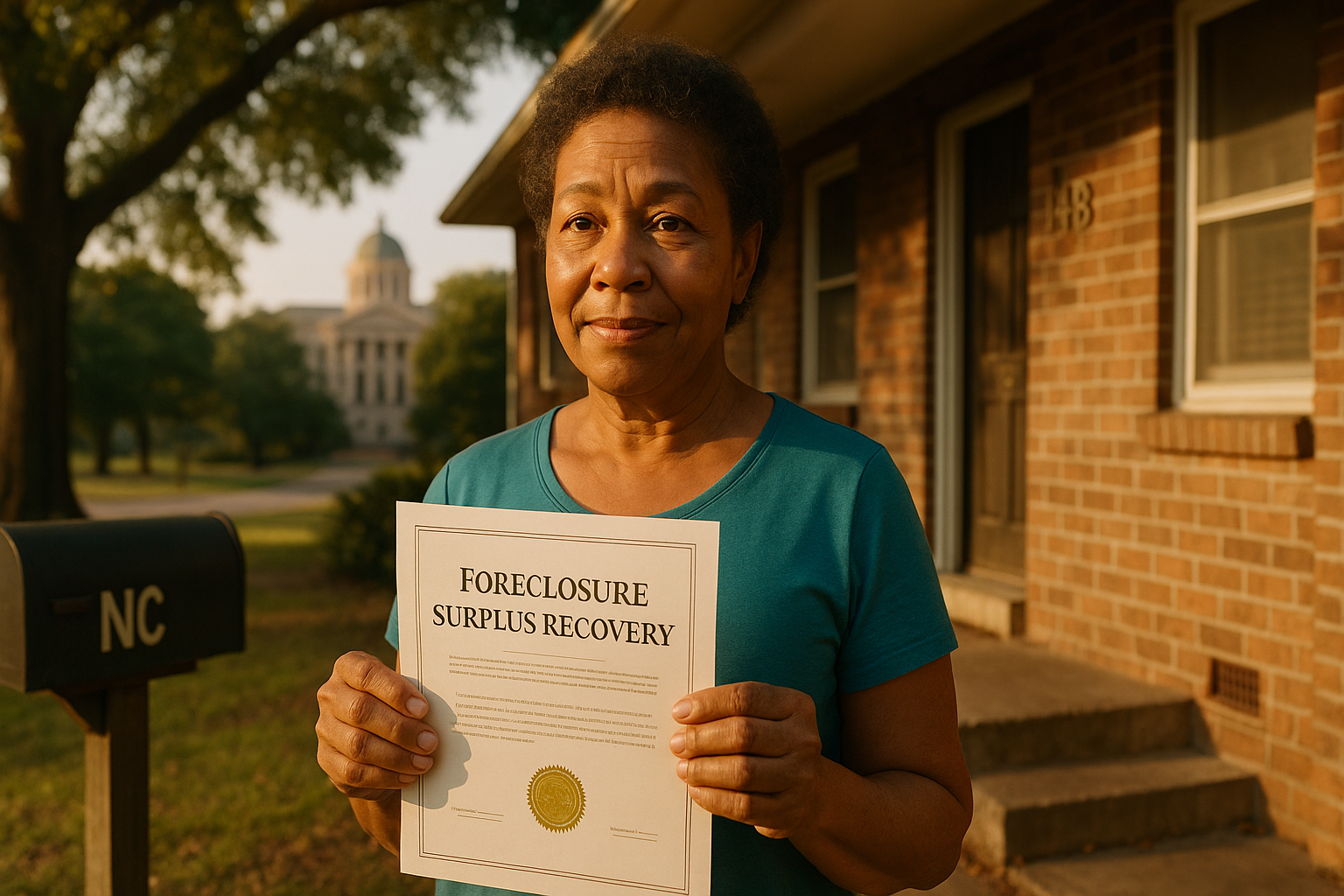
How do I claim surplus funds in Guilford County?
Short answer: In Guilford, you file a verified Petition for Surplus Funds as a special proceeding at the Greensboro courthouse under N.C.G.S. 45-21.32. The petition has to name every possible claimant, and the clerk then holds a hearing to decide who is owed what.
In Guilford County, foreclosure surplus is held by the Clerk of Superior Court under N.C.G.S. 45-21.31 and claimed through a special proceeding under N.C.G.S. 45-21.32. The steps run the same from case to case:
Confirm the surplus exists and that the clerk is holding it, using the foreclosure file number.
Prove who owned the property at the time of the sale, usually with the recorded deed and deed of trust.
Draft and file the Petition for Surplus Funds, citing N.C.G.S. 45-21.31. See our overview of how to claim surplus funds in North Carolina.
Serve every other person or entity that might claim the funds, so the clerk can resolve all claims together.
Attend the clerk's hearing, then receive the order directing the surplus to be paid out.
Greensboro or High Point: where do I file?
Short answer: Guilford surplus claims are filed with the Clerk of Superior Court at 201 South Eugene Street in Greensboro, not the High Point courthouse. The office opens Monday through Friday, 8:30 a.m. to 5:00 p.m., and closes for lunch from 12:45 to 1:45 p.m.
Because surplus follows the foreclosure, a Guilford County sale is claimed at the Guilford County Clerk of Superior Court. A few practical details save a wasted trip:
The clerk's office closes for lunch from 12:45 to 1:45 p.m., so plan around that window.
Park in the lot next to the Greensboro courthouse at South Eugene and Washington Streets.
High Point has its own courthouse, but Superior Court special proceedings are filed in Greensboro.
Proof of ownership comes from the Guilford County Register of Deeds.
If a claim is disputed, it can move to Guilford County Superior Court for trial, as explained below.
Who can claim surplus funds in North Carolina?
Short answer:North Carolina pays surplus out in a fixed order under N.C.G.S. 45-21.31: costs and the trustee first, then taxes, then the foreclosing loan, then junior liens, and finally the former Guilford owner. A deceased owner's heirs inherit that final position.
North Carolina treats surplus as standing in the place of the land, so the same claims that attached to the property attach to the money in the same order of priority. Parties who may have a claim include:
The former owner who lost the property at the foreclosure sale.
Heirs or the estate of a former owner who has died, covered in our guide to claiming surplus funds for a deceased relative.
Junior lienholders and second mortgage holders whose liens predate the sale.
Judgment creditors and federal or state tax liens, depending on when they attached.
Can I claim a deceased owner's surplus funds in Guilford County?
Short answer: Yes, through the estate. When a Guilford owner has died, the personal representative files the surplus claim, and N.C.G.S. 45-21.31 sends the money to the clerk until one qualifies. Opening the estate first is usually the necessary starting point.
This is one of the most common and most valuable situations, and it is where families lose money by moving slowly or letting a finder step in. A relative cannot simply collect the funds; the person with authority to act for the estate files the claim. Plan on gathering estate qualification letters, the recorded deed and any deed of trust, the foreclosure file number, and proof of heirship if entitlement runs to heirs.
How long do I have to claim surplus funds in North Carolina?
Short answer: Guilford sets no hard filing deadline under N.C.G.S. 45-21.32, but waiting invites two risks: another claimant filing first, and the funds escheating to the State as unclaimed property. The safe move is to verify and file while the money is still at the courthouse.
So there is time, but it works against you. You can read more on how long you have to claim. Money still held by the Guilford County clerk is claimed through the special proceeding. Money that has already moved to the State is searched and claimed separately through the NC Department of State Treasurer at NCCash.com.
How much does it cost to claim surplus funds?
Short answer: Plan on roughly $120 to file, plus a title search and service on other parties. Most Guilford surplus claims are structured so the attorney fee is paid from what is recovered, which keeps upfront cost low or nonexistent.
(about $120, set statewide by statute)
(often $150 to $250)

Why work with Surplus Funds Attorney on a Guilford County claim
We regularly handle surplus funds petitions before Clerks of Superior Court throughout North Carolina. What that means for your claim:
Founded and led by Jason Walls, J.D. (Campbell University, undergraduate at NC State), North Carolina State Bar #34274, with 20+ years of practice and membership in WealthCounsel.
We know the Guilford County Clerk of Superior Court process for special proceedings at the Guilford County Courthouse in Greensboro.
We serve the Triad and the surrounding area, including Forsyth, Alamance, Randolph, and Rockingham counties, through our Triad surplus funds recovery.
We handle claims for relocated and out-of-state former owners, so you do not have to return to the county of sale.
What not to do when a finder calls
Protect your claim: Because foreclosure records are public, finders often reach Greensboro former owners before they realize the money is theirs, and many take a large percentage for paperwork you can have handled directly. People who locate funds for a fee face licensing limits in North Carolina. Before you sign anything, read how surplus funds finders operate, and keep these in mind:
Do not assign a percentage of your funds before you know what they are worth.
Do not give a recorded statement or sign over rights to a stranger who called you.
Do not assume a finder is a lawyer. Recovering the money is a court proceeding.
Surplus funds vs unclaimed property: two different pots
People searching NCCash.com sometimes confuse two separate things, which matters in Greensboro because the two are claimed in different places.
North Carolina surplus funds law at a glance
In North Carolina, foreclosure surplus is paid to the Clerk of Superior Court of the county where the sale occurred under N.C.G.S. 45-21.31.
A claimant determines ownership of that surplus through a special proceeding before the clerk under N.C.G.S. 45-21.32.
If an answer raises a factual dispute over ownership, the proceeding transfers to the Guilford County Superior Court civil issue docket for trial, and the clerk may require a $200 cost bond. The clerk's decision can be appealed within 10 days and is heard de novo.
Frequently asked questions about Guilford County surplus funds
-
In Guilford, you file a verified Petition for Surplus Funds as a special proceeding at the Greensboro courthouse under N.C.G.S. 45-21.32. The petition has to name every possible claimant, and the clerk then holds a hearing to decide who is owed what.
-
Guilford surplus claims are filed with the Clerk of Superior Court at 201 South Eugene Street in Greensboro, not the High Point courthouse. The office opens Monday through Friday, 8:30 a.m. to 5:00 p.m., and closes for lunch from 12:45 to 1:45 p.m.
-
North Carolina pays surplus out in a fixed order under N.C.G.S. 45-21.31: costs and the trustee first, then taxes, then the foreclosing loan, then junior liens, and finally the former Guilford owner. A deceased owner's heirs inherit that final position.
-
Yes, through the estate. When a Guilford owner has died, the personal representative files the surplus claim, and N.C.G.S. 45-21.31 sends the money to the clerk until one qualifies. Opening the estate first is usually the necessary starting point.
-
Guilford sets no hard filing deadline under N.C.G.S. 45-21.32, but waiting invites two risks: another claimant filing first, and the funds escheating to the State as unclaimed property. The safe move is to verify and file while the money is still at the courthouse.
-
Plan on roughly $120 to file, plus a title search and service on other parties. Most Guilford surplus claims are structured so the attorney fee is paid from what is recovered, which keeps upfront cost low or nonexistent.

Check whether a Greensboro surplus is yours
If a Guilford foreclosure left money behind, it is sitting with the Greensboro Clerk of Court, not High Point, and we can confirm whether it belongs to you. If we can be of assistance to you, please reach out to us at 919-647-9599, or request a free claim review. We file Guilford claims and handle them for owners who have moved on.
Legal disclaimer: This page provides general information about surplus funds law in North Carolina. It is not legal advice. Every case is different and results depend on the specific facts and circumstances. Reading this information does not create an attorney-client relationship. For advice about your situation, contact a licensed North Carolina attorney. Past results do not guarantee a similar outcome in your case.